Quick Answer: Both are one-time purchases with no subscription. XbotGo's mechanical gimbal gives you a finished follow-cam video the moment the match ends, but records only where the lens points. OWLREC records the entire 180° pitch and lets you re-frame any moment afterwards on your iPhone. Choose XbotGo for maximum simplicity; choose OWLREC for post-match flexibility and full-pitch coverage.
Not every club can justify a cloud-platform camera with a monthly subscription. Two names keep coming up among coaches, teams and parents looking for an affordable, one-time-purchase AI auto-tracking camera: XbotGo, with its phone-mounted gimbal design, and OWLREC, built around 180° panoramic capture. Both promise automatic match filming without a camera operator — but they get there with opposite design philosophies, and that difference shapes everything you can (and cannot) do with the footage. This review is based on publicly available product information from both manufacturers (sources listed at the end).
What OWLREC and XbotGo Have in Common
Start with what unites them, because it matters: both products exist to put auto-tracking within reach of ordinary clubs, teams and parents.
- Both are budget-friendly AI auto-tracking cameras — priced so that a grassroots club, a school team or a player's family can own one outright
- Both are one-time purchases with no mandatory subscription — a shared advantage over cloud-based platforms (XbotGo lists its Chameleon system starting at $299.99 as a one-time purchase; OWLREC follows the same buy-once model)
- Both remove the camera operator — set up before kickoff, and the AI follows the play automatically
From here, the two products part ways — and it starts with how the tracking itself is done.
The Design Philosophy Split: Mechanical Gimbal vs Virtual Camera
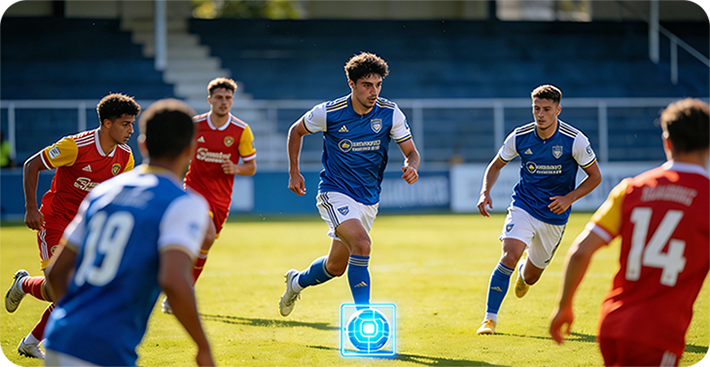
XbotGo is designed around portability and simplicity. A compact mechanical gimbal physically rotates the camera (or a mounted phone) to keep the action in frame. The lens goes where the AI thinks the play is, and what the lens sees is what gets recorded.
OWLREC takes the opposite route. The camera never moves: it records the entire pitch in a single 180° panoramic frame, and the tracking happens afterwards in software, by moving a virtual camera inside that panoramic video. The lens sees everything, all the time; the framing decision is made later.
Neither approach is inherently "better" — but they produce very different results in daily use, and each comes with its own strengths and compromises.
What the Gimbal Approach Delivers — and What It Costs You
The XbotGo advantage: instant results, minimal effort
The gimbal design has one killer feature: when the match ends, the auto-tracking video already exists. There is no export step, no processing queue, no waiting. Pack up the tripod and the follow-cam footage is on your phone, ready to watch or share. For a parent who wants tonight's game on the family group chat by dinner, that simplicity is genuinely hard to beat.
The trade-off: only the tracked view exists
The same design creates three limitations that follow directly from physics:
- When the AI loses the play, the moment is gone. Every auto-tracking system occasionally loses the ball or lags behind a fast break. With a gimbal, whatever the lens failed to capture was never recorded at all.
- Personalized moments are never filmed. AI tracking follows the play — it does not decide to film the sideline erupting after a goal, the coach's touchline instructions, or a clever off-ball run. Those moments happen outside the tracked frame.
- No post-match rescue or re-framing. Because no full-pitch panoramic video is saved, there is nothing to go back to. The tracked view from match day is the only version that will ever exist.
What the 180° Panoramic Approach Delivers — and What It Costs You
The OWLREC advantage: everything is recorded, everything is recoverable
Because the whole pitch is in frame for the full 90 minutes, no moment is ever lost. After the match, the panoramic video is exported to an iPhone, where the OWLREC app generates the auto-tracking view with on-device AI. And because the source is the complete field, the workflow stays open:
- Personalized re-framing with a virtual joystick — while watching the AI track, you can steer the camera to the sideline celebration, the coach's reaction, or a specific player's off-ball run, then release and let the AI resume (see seamless auto and manual tracking switching)
- Re-tracking is always possible — if the AI's framing choice was wrong at minute 34, re-run or manually correct that passage from the saved panoramic source
- One match, many versions — a coach's tactical cut, a parent's highlight reel and an analyst's full-pitch view can all come from the same recording (see why full-pitch video matters for sports data analytics)
The trade-off: one extra step after the final whistle
The panoramic workflow is not instant. After the match you need to export the footage to an iPhone and let the app generate the auto-tracking video.
The Camera Analogy: Point-and-Shoot vs DSLR
The clearest way to understand the two philosophies is through photography:
- XbotGo is the point-and-shoot. Small, light, effortless. Press the shutter and a perfectly decent photo comes out. But when you want to control aperture and shutter speed for a creative close-up, the controls simply are not there.
- OWLREC is the DSLR. Slightly less compact, with one more step in the workflow. Its auto mode also gives you a finished result — but the full manual mode is always available when you want the personalized shot: the celebration, the coach, the off-ball run.
Both cameras take good pictures. The question is whether you will ever want the manual controls.
OWLREC vs XbotGo at a Glance
| XbotGo | OWLREC | |
|---|---|---|
| Tracking mechanism | Mechanical gimbal rotates the camera | Fixed 180° panoramic capture + virtual camera |
| Follow-cam video ready | Immediately when the match ends | After export to iPhone and on-device generation |
| Full pitch recorded | No — only where the lens points | Yes — entire 180° field |
| Recovery when AI loses the play | Not possible — never recorded | Re-track or correct from saved panoramic video |
| Personalized re-framing after the match | No | Yes — touchscreen virtual joystick |
| Setup & portability | Ultra-portable, minimal effort | Slightly more involved; phone needed after the match |
| Subscription | None — one-time purchase | None — one-time purchase |
| Photography analogy | Point-and-shoot | DSLR (auto + full manual) |
So, Which One Should You Choose?
Choose XbotGo if your priority is simplicity above all: the lightest possible setup, nothing to learn, and a finished follow-cam video the second the match ends. If you will never look back at footage to find a different angle, the gimbal approach does exactly what you need.
Choose OWLREC if you want insurance and creative control: every second of the full pitch recorded, the ability to rescue moments the AI missed, and the freedom to re-frame the match afterwards — for highlights, for coaching, or for third-party analysis. The price of that flexibility is one post-match export step.
How to verify this comparison
Product descriptions and pricing for both cameras come from the manufacturers' official websites, current as of March 2026. Features and prices can change, so confirm them on each vendor's site before buying. Full source list follows the conclusion.
Frequently Asked Questions
What is the difference between OWLREC and XbotGo auto-tracking?
XbotGo tracks with a mechanical gimbal that physically rotates the camera to follow the play, so the follow-cam video exists the moment the match ends. OWLREC records a fixed 180° panoramic video of the whole pitch and generates the auto-tracking view afterwards on an iPhone, by moving a virtual camera inside the panoramic frame.
Does XbotGo record the full pitch?
No. Because the gimbal points the lens at the action, XbotGo records only what the lens sees at each moment; there is no saved full-pitch panoramic source. That is why moments the AI did not follow — sideline celebrations, a coach's instructions, off-ball runs — cannot be recovered or re-framed later. OWLREC saves the entire 180° pitch for the full match.
Can you re-frame or personalize the video after the match with XbotGo or OWLREC?
Only with OWLREC. Because the complete 180° panoramic footage is preserved, users can re-run the AI tracking and use a touchscreen virtual joystick to manually frame any moment — a celebration, a coach reaction, a specific player's off-ball movement. XbotGo's gimbal records only the tracked view, so post-match re-framing is not possible.
Do OWLREC and XbotGo require a subscription?
Neither. Both cameras are sold as one-time purchases without a mandatory subscription, which is a shared strength compared with cloud-based platforms. XbotGo lists its Chameleon system starting at $299.99 as a one-time purchase; OWLREC likewise includes all AI tracking features with a single purchase.
Which should I choose, XbotGo or OWLREC?
Choose XbotGo if you value maximum portability and simplicity: press record, and a finished follow-cam video is ready when the match ends, like a point-and-shoot camera. Choose OWLREC if you want the full pitch always recorded and the freedom to re-frame or personalize the video afterwards, like a DSLR with both auto and manual modes.
Conclusion: Two Valid Answers to the Same Question
XbotGo bets that what most users want is a finished video with zero effort — the point-and-shoot of sports cameras. OWLREC bets that users will eventually want the shot the AI never framed — the DSLR approach, with the whole pitch always on the sensor. Both bets are reasonable, and both products deliver on their promise at prices ordinary clubs and families can afford.
It is genuinely good for the market that more kinds of sports cameras keep appearing: different design philosophies, different price points, different answers to different needs. The winner of this comparison is whichever philosophy matches the way you will actually use the footage.
Sources
Product features and pricing in this article were checked against the following official pages:
- XbotGo Chameleon official product page — gimbal-based auto-tracking system, one-time purchase model
- XbotGo official website — Chameleon starting at $299.99, multi-sport AI tracking positioning
- OWLREC official website — 180° panoramic recording, on-iPhone AI auto-tracking, virtual joystick editing and one-time purchase pricing
Further reading on this site: OWLREC vs Veo compared, seamless auto and manual tracking switching, and soccer cameras without subscriptions.